

The Possibilities of Progress
A Christian Worldview on Human Innovation

Dear friends,
I want to share with you a remarkable commentary from one of our leading Christian thinkers. Jeremy Boreing’s newest broadcast — concerning the theology of man and work as applied to the extraordinary advances in technology, and particularly machine-learning predictive technologies — is an absolute classic:
I hope you will follow the link to this remarkable resource.
At the same time, I have been thinking about these things in relationship to higher education — and in particular, theological higher education. We are all, of course, applying what we are learning to our own vocations. My findings were no different than Jeremy’s. Technology is now, and will always remain, in the hands of the individuals who build it — for good or for ill. The past observable experiences of moving from horse and buggy to automobile, from radio to television, from trains to aircraft, have all followed a particular and predictable pattern: unveiling (“gradually then suddenly”) hesitancy to adopt the new technology, uncontrolled growth (I call it the “Sutter’s Mill syndrome”), then, a sifting (the strong, the wise survive, excesses are removed, losses, consolidation), economic disruption, adjustments, and the new norm.
We can expect similar things ahead. Of course there are differences. In one of the greatest differences is that of scale. It is a global phenomenon and all of the developed countries are getting in on the new thing. If you were to ask me where are we in my predictable pattern for the introduction of technology, I would say as of this date we’re going to be moving into a sifting. We will likely find that machine learning and other predictive technologies are helpful in one area and are nothing more than amusement in others. Not that amusement is unimportant. Nor is it unprofitable – to the contrary. Yet some of the things that have come out in recent days and weeks will be found to be less useful to human beings. Yet, other industries like medicine, defense, manufacturing, utilities,and of course computer engineering will be able to harness the new technology for Good. Bad actors, from nation states to cartels and malicious individuals, will create vast dark networks that use the technology for evil.

In the meantime, it is ours for the taking. Generative AI is something of a Roman road — engineered and often built by humanists. But as Saint Paul and the other apostles used the engineering of the Roman Empire to advance the gospel of Jesus Christ (Acts 19:21; Romans 1:15; 15:19), we can do the same. The infrastructure was not Christian; the mission was. Nothing has changed.
I write about this in the book below, which is available at all your favorite booksellers. But first — be sure to listen to Jeremy’s broadcast. And as you do, think carefully about how we can use what is coming to us for good. For where sin abounds, grace abounds all the more (Romans 5:20).
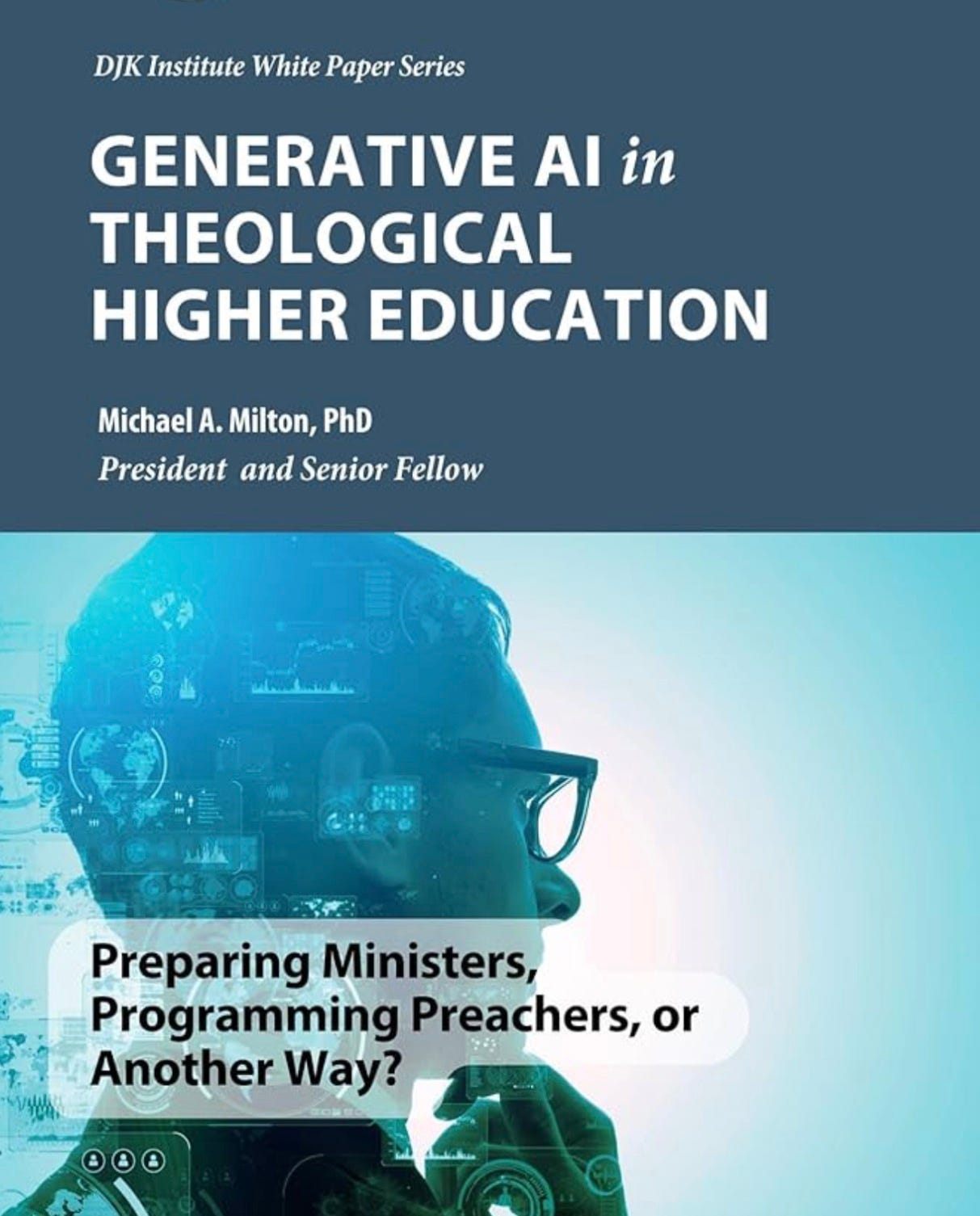
For those interested in technology and education you might consider my book: Generative AI in Theological Higher Education (DJK Institute), available on all booksellers including Amazon: https://amzn.to/3RmacpV.]
A Word on Other Ministries
MUSIC
I write, perform, and record songs about stories of grace, loss, redemption under my full name, Michael Anthony Milton. We have five albums and numerous sings released. I’m finishing up what will likely be my final album. It’s folk music with a Christian world and life view. Our prayer is that the music heals the wounded soul and nourishes pilgrims along their way.
You can learn more about my music at any on the music streaming services, Spotify, Apple, Amazon, Pandora, or YouTube Music:
Michael Anthony Milton on YouTube Music
https://music.youtube.com/@faithforlivinginc?feature=shared
The channel also features music videos like this one:
“Jesus Came”
This video features a long time vocal accompanist, Miss Cindy Gibbs.
https://music.youtube.com/watch?v=25rn1YafPxk&feature=shared
“Jesus Came.” Words and Music © Ⓟ 2012 Michael Anthony Milton (Bethesda Music Group, BMI).
Thank you for listening and reading.