

The Painter's Confession
Turner, the Theology of Light, and the Christ Who Enters the Darkness

Dear Friends,
If you have been with us for a while, you know that I like to write on a variety of subjects. You might also know that I seek to show how these diverse subjects serve the Gospel of Jesus Christ. So, for the past several days, I have thought about the article that follows. While it might appear that an article on the study of light and shadow in visual art is tediously uninteresting, I believe the insight, drawn from God’s revelation in Creation as well as His Word, the Holy Bible, provides a corrective to our understanding of the nature of sin and the glory of salvation in Christ. Gaining this insight for yourself will lead to clarity about, and perhaps even an escape from the tyranny of shadows in this present age. If it helps you to turn to the Light of the World who invades the shadows of our lives to deliver us, then our most ambitious prayers for the project will have been answered.
Yours Faithfully,
Mike
This article is from the latest white paper from the DJK Institute of Reformed Leadership: Art and Theology Series, No. 1 · The D. James Kennedy Institute of Reformed Leadership. You may download the white paper at no cost.

“Arise, shine, for your light has come, and the glory of the LORD has risen upon you. For behold, darkness shall cover the earth, and thick darkness the peoples; but the LORD will arise upon you, and his glory will be seen upon you.”— Isaiah 60:1–2 (ESV)
“I am the light of the world. Whoever follows me will not walk in darkness, but will have the light of life.”— John 8:12 (ESV)
◆ ◆ ◆
I. “The Sun Is God”
Joseph Mallord William Turner (1775–1851), the English landscape painter whose canvases altered the way the West would see for a hundred years afterward, lay dying in a small house at Chelsea on the morning of 19 December 1851. Those who attended him recorded his last words. Accounts differ, as such accounts often do. Some have him saying, “The sun is God.” Others, “God is the sun.”1 The difference matters less than what the dying painter was reaching for, which was not a doctrine but a confession.
He was not, I think, declaring himself a heliotheist. He was saying, in the only grammar a painter has, that light is everything — that without it nothing can be seen, nothing can be known, nothing can flourish. And in this, he stood firmly within the Christian Scriptures, which announce from beginning to end that God is light, and in him is no darkness at all (1 John 1:5). Turner had spent fifty years bending the language of paint toward that single confession.
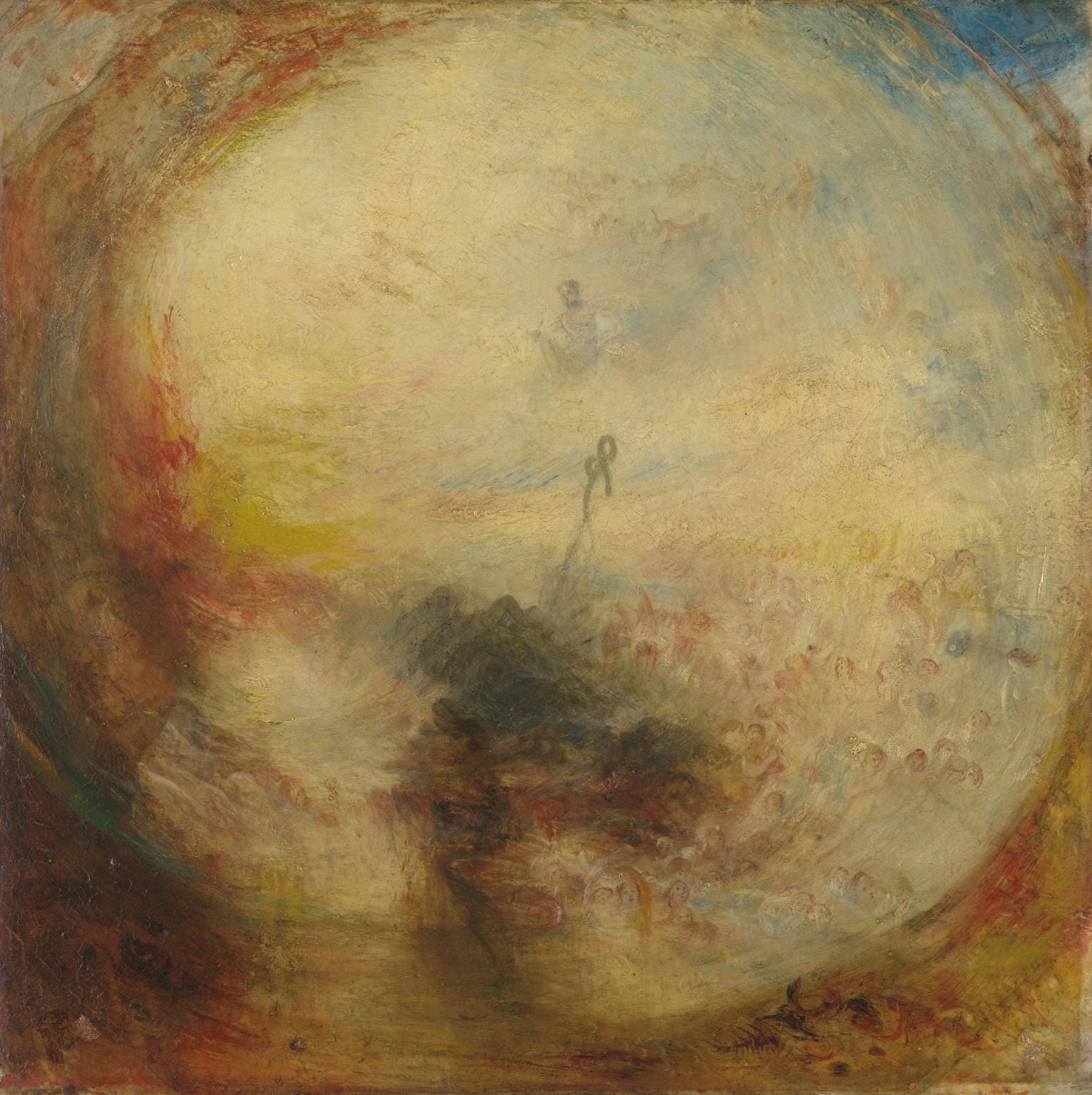
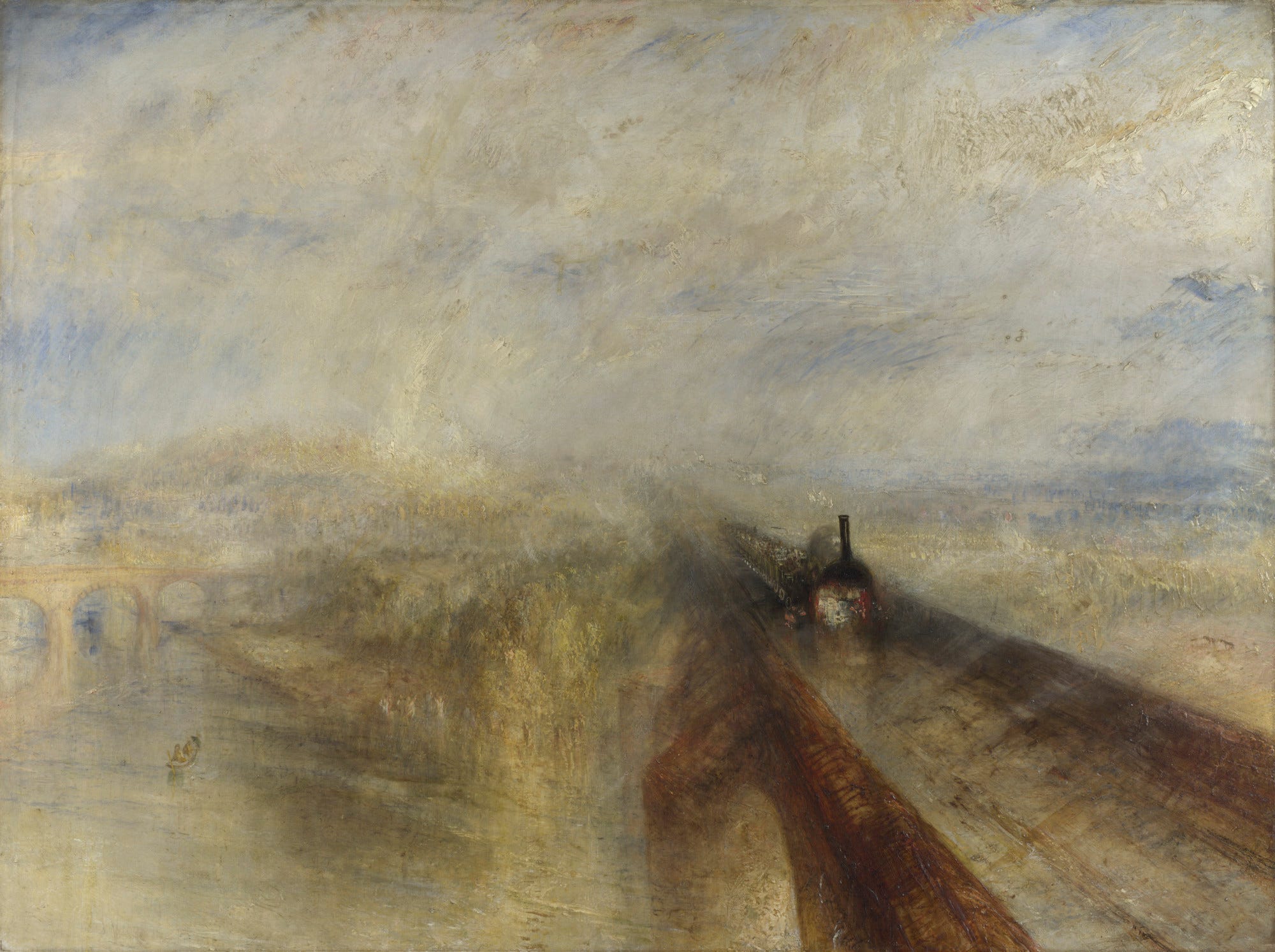
Look at Turner’s later works. The sky burns. The sea takes fire. The shoreline dissolves into atmosphere. By the 1840s, in pictures such as Rain, Steam and Speed — The Great Western Railway (1844) and the great study from Goethe, Light and Colour (1843), the canvas has become almost wholly luminous, the subject all but absorbed into its medium. The critics complained that one could no longer find the picture. They were wrong, but understandably so: Turner had begun painting the light itself. He is classed, properly, among the Romantics, but I have long thought of him as a proto-Impressionist — the painter who taught Monet how to look.2
This is more than a footnote in art history. Turner’s discipline of seeing — his patient study of light, perspective, and the casting of shadows — yields lessons that belong to theology. They have to do with God, with evil, and with the redemption that comes through Jesus Christ, who dispels darkness.3
When he uttered his last words, “The sun is God,” JMW Turner was not, I think, declaring himself a heliotheist. Turner might have been a confused Christian, but he was not a pagan. Turner was saying, in the only grammar a painter has, that light is everything — that without it nothing can be seen, nothing can be known, nothing can flourish. And in this, he stood firmly within the Christian Scriptures, which announce from beginning to end that God is light, and in him is no darkness at all (1 John 1:5).
◆ ◆ ◆
II. What a Shadow Actually Is
We are accustomed to thinking of a shadow as a kind of thing in itself, an extension of the object that casts it, almost a companion. But a shadow is not the object’s emissary. A shadow is what happens when an object interrupts a source of light. Strictly speaking, the shadow is not attached to the object at all; it is the region on the far side where the light has been prevented from reaching. Remove the object, and the shadow is gone — not because the object dragged it away, but because the light, no longer interrupted, fills the space.
This small point of optics has a large theological consequence. It means that darkness in the moral and spiritual sense is also not a thing in itself. It is the result of an interplay — the interplay between a source of light and something that has come between that source and the place where the light should have fallen. Augustine of Hippo (354–430) taught the Church to speak of evil as privatio boni, the privation of the good. He was right.4 But we may extend his vocabulary by saying: evil is the shadow cast when something stands between us and the God who is light.
The object that casts the shadow may be placed by nature — a sickness, a body breaking down, the slow attritions of a fallen world. It may be placed by the hand of man — a sin committed, a war waged, an injustice tolerated. It may even, in rare and sober cases, be placed by God himself as a judgment. And often, more often than we like to admit, the object is placed by our own hand, against our own light. We block the sun, and then we wonder why it is cold.
◆ ◆ ◆
III. Evil as the Shadow of Sorrow
Because we live in a fallen world, objects intrude. They get in the way of human flourishing, and they get in the way of the light source itself — the God whose love is the warmth in which all flourishing happens. Evil, then, is an object that casts a shadow of sorrow. And sorrow exists wherever life has been cut off from light.
This is what the prophet Isaiah saw, centuries before Turner picked up a brush. “The people who walked in darkness have seen a great light; those who dwelt in a land of deep darkness, on them has light shone” (Isaiah 9:2). The prophet does not say the people made their own torches. He does not say the darkness was an illusion. He says a light shone upon them — unbidden, from outside, in mercy. And later, in that great oracle to a discouraged Jerusalem: “Arise, shine, for your light has come” (Isaiah 60:1).
The light that Isaiah promised has a name and a face. He stood one day in the temple court at the Feast of Tabernacles, when the great lamps were burning in the Court of the Women, and he said it plainly: “I am the light of the world. Whoever follows me will not walk in darkness, but will have the light of life” (John 8:12). It was no metaphor. It was, and is, the central fact of the Christian gospel.
◆ ◆ ◆
IV. Two Ways the Light Comes
Now here is where the painter’s vocabulary helps the preacher. Christ, the light of the world, does his redemptive work in two ways, and both of them are visible in Turner’s canvases if we know how to look.
First, sometimes Jesus removes the object. The sickness is healed. The sin is forgiven and the guilt taken away. The estrangement is reconciled. The chain falls off. The object that was blocking the light is taken down, and the light pours in again from its proper source, and what had been shadow is now ordinary daylight. This is the kind of redemption we instinctively pray for, and rightly so.
But second, and more often than we might wish, the object remains. The disease is not lifted. The grief does not pass. The war continues. The wound aches. The world keeps doing what a fallen world does. And here is the marvel of the gospel: when the object cannot be moved, Jesus does not abandon the dark side of the object. He goes there. He enters the shadow himself. He positions himself so that, even though we are on the far side of the blocking thing and cut off from the original light, he becomes the light we need.
This is the consolation that has held the saints through every long affliction. The pillar of fire stood with Israel in the wilderness, not above it (Exodus 13:21). The Son of God was named Immanuel, God with us, before he was named anything else (Matthew 1:23). The fourth man in the furnace walked in the fire alongside the three who would not bow (Daniel 3:25). And our Lord, on the night he was betrayed, said to his disciples, “I will not leave you as orphans; I will come to you” (John 14:18). He keeps the appointment. Where he is, there is light, even if the object that blocked the sun is still standing.
◆ ◆ ◆
V. The Western Twilight
There is a sobering corollary to all this, and we ought to name it. In much of the modern Western world, we have undertaken a long experiment in removing the person of Jesus from the public square — from the schools, from the courts, from the conscience of the culture. We did this, many of us, with confidence, believing the objects of human misery had been overcome by progress, science, and good intentions. The shadow, we thought, was a relic of an unenlightened age.
But the objects were always there. They did not go away because we stopped naming them. And when the light of the world was politely shown the door, the objects began once again to throw their shadows across the land, and we have found ourselves returning by degrees to a condition Isaiah would have recognized at a glance: “darkness shall cover the earth, and thick darkness the peoples” (Isaiah 60:2). The objects have not been defeated by our cleverness. Only the Light of the World defeats them, either by removing them or by entering the shadow with us.
Abraham Kuyper (1837–1920) saw this clearly more than a century ago, and his witness still stands.5 There is no square inch of the human world that does not belong to Christ, and no corner of culture — not art, not law, not learning, not the family table — that can finally do without him. Where he is welcomed, the light returns. Where he is dismissed, the shadow lengthens.
This is where we find ourselves at this crucial hour.
◆ ◆ ◆
VI. A Prayer for Revival
So we must pray. We must pray for faith to be renewed and for new faith to be born; for a revival of voices welcoming Jesus into their lives — into every room of them, every habit, every fear, every grief. We must pray for the courage to look at the objects that have come into our own lives and to ask the Lord either to remove them, or, if in his wisdom he leaves them standing, to come and be the light on our side of the shadow.
This is the gospel we received and the gospel by which we are saved: that the Lord Jesus Christ was crucified for our sins, was buried, and was raised on the third day in accordance with the Scriptures, and that he was seen by many witnesses (1 Corinthians 15:3–6). He ascended into heaven, where he hears our prayers and intercedes for us (Hebrews 7:25). And he is coming again (Acts 1:11). The light has begun to shine, and it will not be put out.
Until the day when every object is removed — every sickness, every sorrow, every shadow of every sin — in the new heaven and the new earth that God has promised (Revelation 21:1–4), we may trust the Lord Jesus Christ, the Light of the World. And we may be sure that we will once again experience, fully and forever, the nourishing, revealing, cleansing power of the light. For in the city to come, “there will be no night there” (Revelation 22:5).
God is light. God is love. And the sun, which Turner mistook for God, is only the first faint witness to the One who made it.6
Yours Faithfully,
Michael A. Milton, PhD
Tryon, North Carolina
Notes
1. The account of Turner’s deathbed words is preserved by his friend and physician (variously identified in early sources) and has been transmitted in two principal forms: “The sun is God” and “God is the sun.” See Walter Thornbury, The Life of J. M. W. Turner, R.A. (London: Chatto and Windus, 1877); James Hamilton, Turner: A Life (London: Scepter, 1997), 354–56; and Anthony Bailey, Standing in the Sun: A Life of J. M. W. Turner (London: Sinclair-Stevenson, 1997).
2. On Turner’s late atmospheric works and their anticipation of Impressionism, see John Gage, J. M. W. Turner: ‘A Wonderful Range of Mind’ (New Haven: Yale University Press, 1987), and Andrew Wilton, Turner in His Time (London: Thames & Hudson, rev. ed. 2006). On Goethe’s influence, see Light and Colour (Goethe’s Theory) — The Morning after the Deluge (1843), Tate Britain, London.
3. On the legitimate place of the visual arts within a Reformed theology of culture, see Hans Rookmaaker, Modern Art and the Death of a Culture (London: Inter-Varsity Press, 1970), and Francis A. Schaeffer, Art and the Bible (Downers Grove, IL: InterVarsity Press, 1973). For a recent treatment in the same tradition, see Michael A. Milton, Reframing: Art in Light of the Reformation (Bethesda Publishing Group, 2026).
4. Augustine, Enchiridion XI; cf. Confessions VII.12.18. The classic Augustinian formulation of evil as privatio boni — the privation of good — is here being extended, not denied: privation is occasioned by an obstructing reality, not by metaphysical emptiness alone.
5. Abraham Kuyper, Lectures on Calvinism (Grand Rapids: Eerdmans, 1931), Lecture III, “Calvinism and Politics,” and Lecture V, “Calvinism and Art.”
6. Unless otherwise noted, Scripture citations are from the English Standard Version (ESV), copyright © 2001 by Crossway. Used by permission. All rights reserved.
NOW AVAILABLE FROM BETHESDA PUBLISHING GROUP
Reframing: Art in Light of the Reformation
Michael A. Milton · Bethesda Publishing Group, 2026
The ideas in this essay find their fuller development in Dr. Milton’s recent volume, which argues that the Protestant Reformation did not impoverish the visual arts but liberated them — freeing painters to depict the full range of human life as worthy of God's glory. Chapters trace the light-saturated canvases of Rembrandt, Vermeer, Turner, and Constable, finding in each a theology of beauty grounded in creation, redemption, and the coming renewal of all things.
Reframing is suited to adult study groups, home educators teaching art history through a Christian lens, and any reader who wants to see the familiar world with new eyes. An excellent companion for courses in aesthetics, church history, or Reformed theology.
🕮 Learn more and order at michaelamilton.com · Also available through major booksellers. Orders through the Amazon link to the book may provide income to Faith for Living, Inc., a North Carolina 501(c)(3) Nonprofit Corporation.

.
◆ ◆ ◆
About the Author
Dr. Michael A. Milton is President and Senior Fellow of Faith for Living, Inc., and head of Bethesda Publishing Group. A minister in the Presbyterian Church in America and a retired United States Army Chaplain (Colonel, 32 years), he has served as a pastor, seminary president, professor, and evangelist, and is the author of more than fifty books. He holds a PhD from the University of Wales, a DMin from Erskine Theological Seminary, an MDiv from Knox Theological Seminary, and an MPA from the University of North Carolina at Chapel Hill. He makes his home in Tryon, North Carolina.
About the Series
This essay is the first in the Art and Theology white paper series from The D. James Kennedy Institute of Reformed Leadership, a ministry division of Faith for Living, Inc. The full annotated and footnoted PDF white paper edition is available upon request. Inquiries: Dr. Rebecca Rine, learnmore@faithfor.living.
A Note on Ethical Writing
The author composes all original material in this publication. In preparing edited, condensed, or adapted versions, the editorial staff may employ AI-assisted tools — including Claude (Anthropic) and Grammarly — to support editorial tasks such as grammar review, condensation, and formatting. These tools are used in the service of the author’s voice and intention, not as substitutes for it. The writing, substance, theology, and expression of the work remain the author’s own.
About the D. James Kennedy Institute of Reformed Leadership
The D. James Kennedy Institute of Reformed Leadership was founded in 2013 by the Kennedy Family and Michael A. Milton to advance the theological vision of the late pastor and evangelist to shepherd the shepherds who shepherd the flock. The ministry is an organizational unit of Faith for Living, Inc., a North Carolina 501(c)(3) nonprofit corporation.
Give to Faith for Living. Founded to fulfill the Great Commission of Jesus Christ by reaching as many as possible through all available means.
◆ ◆ ◆
Soli Deo Gloria