

The Invitation to Rest
Why Matthew 11:28 is So Popular

Dear Friends,
Welcome to our continuing series, Top Ten Most Beloved Bible Verses. You can refer to this introductory article to see them all and to learn about our sources for the survey results. But the truth is, surveys aside, if you are a believer in the Lord Jesus Christ for even a few years, you likely are familiar with most or all of these passages. My pastoral work is to locate these passages in their larger scriptural context, faithfully guide us to “dive” like those Pacific islander boys, the “deep water pearl seekers,” into the crystalline turquoise waters of the larger context, bringing up the precious pearls of biblical truth, stringing them together with the rest of the Gospel gems, and adorn our lives with the priceless necklace of biblical beauty.
Today, we come to another verse of comfort in the trials of life: Matthew 11:28.

In studying this favorite verse, it is vital to our understanding to never separate a scriptural citation from its larger context. While I have no fear that you will be like a cultist who does this to his own condemnation as he scatters seeds of confusion amongst the saints, I do think we can miss deeply implanted seeds of lifelong transformation. So, let’s look at the larger section of Scripture:
At that time Jesus declared, “I thank you, Father, Lord of heaven and earth, that you have hidden these things from the wise and understanding and revealed them to little children; yes, Father, for such was your gracious will. All things have been handed over to me by my Father, and no one knows the Son except the Father, and no one knows the Father except the Son and anyone to whom the Son chooses to reveal him. Come to me, all who labor and are heavy laden, and I will give you rest. Take my yoke upon you, and learn from me, for I am gentle and lowly in heart, and you will find rest for your souls. For my yoke is easy, and my burden is light.”
At that time Jesus went through the grainfields on the Sabbath. His disciples were hungry, and they began to pluck heads of grain and to eat. But when the Pharisees saw it, they said to him, “Look, your disciples are doing what is not lawful to do on the Sabbath.” He said to them, “Have you not read what David did when he was hungry, and those who were with him: how he entered the house of God and ate the bread of the Presence, which it was not lawful for him to eat nor for those who were with him, but only for the priests? Or have you not read in the Law how on the Sabbath the priests in the temple profane the Sabbath and are guiltless? I tell you, something greater than the temple is here. And if you had known what this means, ‘I desire mercy, and not sacrifice,’ you would not have condemned the guiltless. For the Son of Man is lord of the Sabbath” (Matthew 11:25–12:8 ESV).
Matthew 11:28 comes in the midst of Jesus’ teaching about His unity with the Father and the yoke of bondage that religion had placed on the people. His invitation, “Come unto Me,” is an open welcoming of those whose spirits are disturbed within them, who have asked the great questions of life and don’t even know where to go for the source of the answers. Jesus is saying what He will detail in other places: “The way to the Father is through Me.” “I am the way, the truth, and the life.” “The Father and I are one.” “If you have seen Me, you have seen the Father.” And to those who see Him as somehow apart from the covenant line of prophetic succession, “Before Abraham was, I AM.” Come unto Me is not only a welcoming for the lost and weary soul to God, but it is also a self-disclosure of Jesus’ divine origins and personhood. The text addresses the full identity of our Lord: He is both Jesus’ identity as fully God and fully Man, never mingled, but existing as surely as Father, Son, and Holy Spirit exist as One God. And the scripture section calls us to see that the laws of Man, as illustrated in the Sabbath observances, are laborious when disconnected from the human good that God’s Word intends. And so we derive from the passage, at least, the following truths:
Jesus is the promised Messiah who is God incarnate.
He brings rest to the search for God and living as a child of God.
The promise is rest: rest from the angst of fretfully following the impulse to understand what are called “the great existential questions” of humanity: “Who am I? Why am I here? Is there a God? What are my duties to Him? What about death? Is there another life beyond this one? What do I do with the guilt that I feel?”—Why? How? What? When?” And on and on.
The promise is rest in a Person: Jesus describes His reign in personal ways: “I am gentle and lowly in heart, and you will find rest for your souls.” His Lordship is contrasted with the religions of this world: “For my yoke is easy, and my burden is light.” The narrative that follows, over restrictions of human beings on the Sabbath, doing good and necessary tasks of life, are manmade rules added to God’s Word that bring unnecessary guilt and burden. For we read Jesus’ condemnation of the religious leaders: “And if you had known what this means, ‘I desire mercy, and not sacrifice,’ you would not have condemned the guiltless [my emphasis]. For the Son of Man is Lord of the Sabbath.”
So, Why Does This Passage Resonate So Much with People of Every Generation?
The passage hits home to each of us because there is a sense of the divine (Calvin) in each of us. We have “eternity in our hearts.” True, “no one seeketh God,” the Bible says, but the idolatry-bent in our human heart (to seek God means to be accountable to Him, not that we don’t know there is a God) does not negate the ache, the longing for home. And once we come to God through repentance and faith in His Son, the Lord Jesus, by the work of the Holy Spirit within us, we travel the pathway of sanctification (becoming increasingly conformed by grace and truth, to His will for our lives as revealed in Scripture), of living life in the Kingdom of God, we face the temptations and trials, stumbling blocks to progress, sinisterly laid by the devil, the flesh, and the world. When you come to believe, you are beset by spiritual opposition from within and from without. And there are the trials that come from living in a fallen world. There is even pain, always pain, from rightly ordered love, for family, friends, and the world around us. We become tired. But we are told not to become weary in well-doing. So how?
“Come unto Me . . .” The invitation from your Savior and Lord is personal, and because He is fully God and fully Man, is spoken with a unique divine empathy. That is why He became like us. He speaks to us out of His own heartbreak.
The cross of Christ is not merely cosmic victory over sin; it is the seal of fulfillment on the ancient covenant—death for sin, perfect righteousness before God. And it is more. It is personal.
We love Matthew 11:28 because, through the Holy Spirit within us, we hear Jesus speaking to us not as “All ye,” but “Thou, Michael.” “Thou, Abbie.” “Thou, Billy.” “Thou, Mary.” “Thou, Barry.” “Thou, Melissa.”
Closing Thoughts
Matthew 11:28 is the Lord Jesus’ personal invitation to know meaning and to locate healing, and to find the answer to our deep eternal longing for God. It is Jesus’ invitation for believers and unbelievers alike. We love it because we need it. We need Him because He made us.
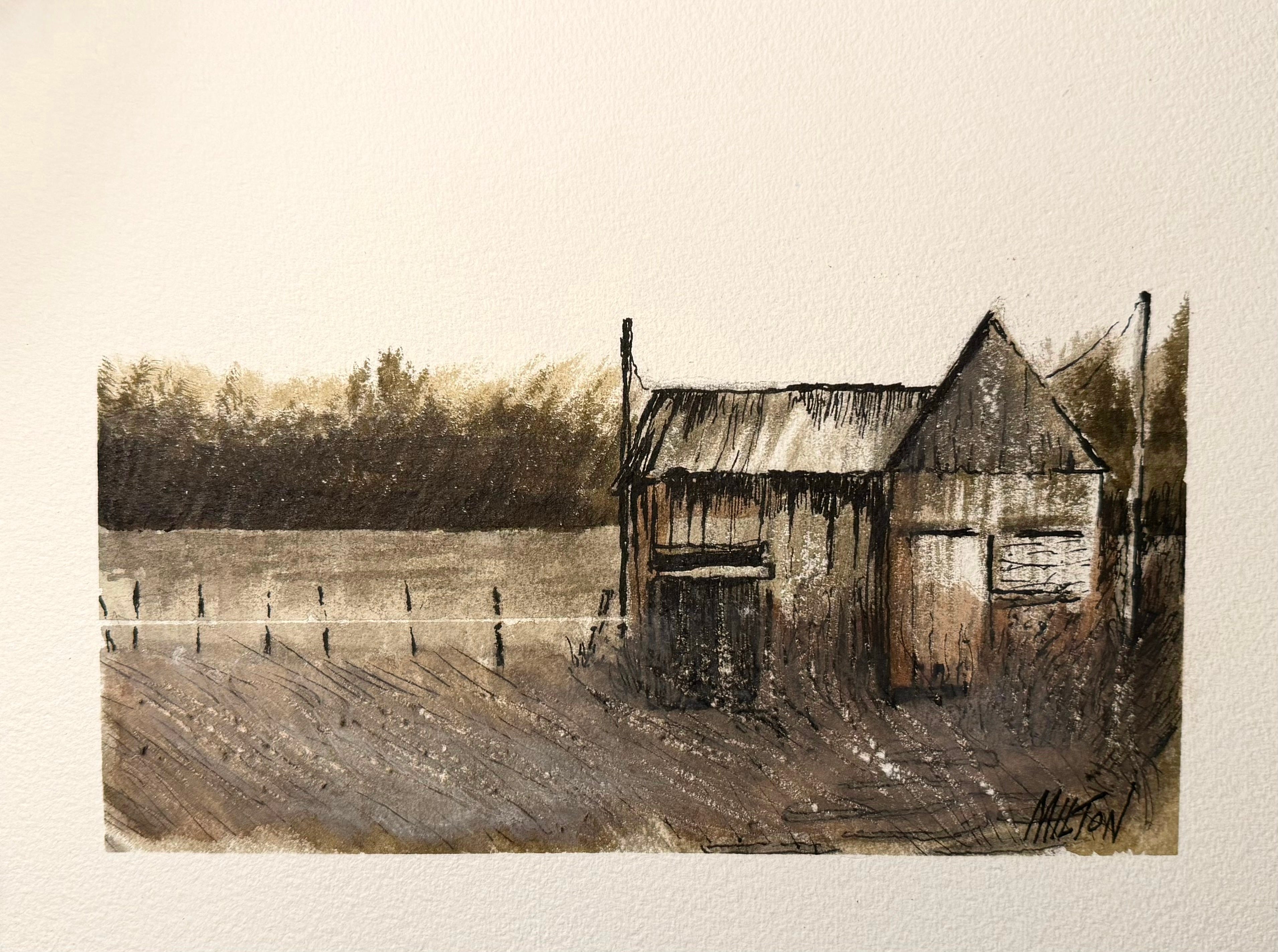
The image that I used for this devotional is that of an old barn. I described the painting with these words:
“This 9 X 12 tonalism project, using sepia ink wash and watercolor, focuses on an old barn from the late 19th and early 20th centuries. It is a picture of a structure that stands as a sign, a monument, however crude, pointing the visitor to an earlier day in the American experience, when the nation was, in the vast majority, an agrarian nation. The rugged spirit of individualism, the can-do mentality, the enduring spirit of faith and land, labor, and prayer remind us of a people centered on the lessons learned from that land. And the greatest lesson is that we need God. On the farm, we are closer to our dependence on God, from the very rhythm of life on earth, to the rain and the sun, and the intricate wonders of the unseen seed in the ground. To those who have lost their way, to visit this place is to come home. It is, thus, “The Reunion Barn.” The Lord Jesus invites weary and worn modern peoples to come home to the One who watched over these farming families: “Come to me, all you who are weary and burdened, and I will give you rest” (Matthew 11:28).1
To you who are caught in the anguish of “Who and Why and How,” to those of you who have found the answer in Jesus, the resurrected, reigning, and soon-coming Savior of all, but who feel the tensions of life in the Kingdom of God being lived in a place where pain still exists: The Lord bids you come. And rest.
Really find rest.
In the name of the Father, and the Son, and the Holy Spirit. Amen.
Taken from the description at The Michael Anthony Milton Gallery on ArtPal. https://www.artpal.com/mamilton?i=164199-305. Accessed 04 August 2026.