

Raining Iguanas
Disorientation and Destination in the Secular Age

“For here we have no lasting city, but we seek the city that is to come.”
—Hebrews 13:14 (ESV)
“I can go wherever I want to go! I am a free man!”
Of course, you are, sir. You may be free to be anywhere you wish, but perhaps you need reminding that there are some places that are not good for you—and some places that are simply incompatible with who you are.
Need proof?
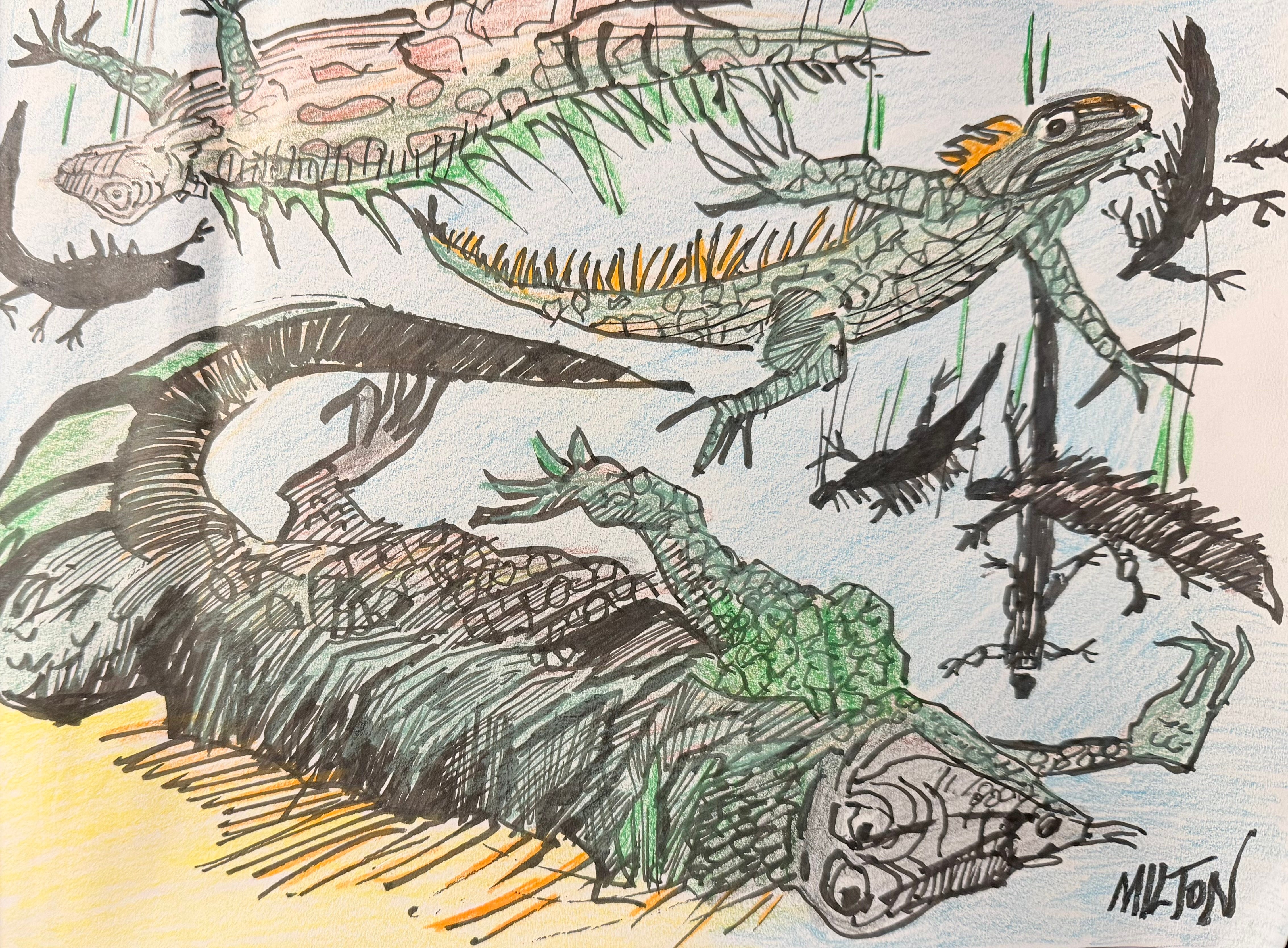
Ask the cold‑stunned green iguanas. It is raining lizards in Florida.
Somewhere in a retirement village in South Florida—Valencia New Life Estates, in this case—this scene has been playing out since the cold snap. It is eight‑thirty in the morning. Bill is a retired insurance agent from Garfield Heights, a town just outside Cleveland, Ohio. Alina—“Lina,” his wife—is preparing a fruit cup for the two of them.
As she moves sprightly about the tract‑home kitchen, with its glistening countertops and crisp white cabinetry, she notices her husband standing still, coffee mug suspended mid‑air. He is fixed on something outside the breakfast‑nook window, mouth slightly open.
“Bill?” Lina says, fear edging past annoyance. “What in the world are you looking at? Get in the game—we’ve got pickleball in an hour with the Merkowskis!”
Bill—Wilhelm Czesław Woźniak—is dressed in his new daily uniform: a tropical shirt (this morning a cheerful Valencia orange), faux pas men’s shorts, his upper‑Midwest tree‑trunk legs pale as catfish bellies, stuffed like Polish sausage into black compression socks and asphalt‑ready tennis shoes.
“Hon?” he says.
“What is it, Bill?”
“What’s the forecast today?”
“Well, it hit thirty‑two last night. We could be in the forties or fifties this morning. Isn’t that something? Almost like Cleveland.” She waits. “Right, Billy?”
The silence unsettles her. Lina looks across the Italian‑Alabama marble counter toward the circular table by the oversized window. Bill does not move.
“Bill, what in the world are you staring at?”
Still trance‑like, he answers softly, “Tell me I’m wrong, Lina, but I think it’s raining lizards.”
She rushes to his side. Leaning over him, hands on his shoulders, eyes widening to match his own, Alina and Wilhelm Woźniak of Garfield Heights, Ohio, watch—unprepared and unbelieving—as dozens of green iguanas drop from their ficus hedge onto the thick Saint Augustine lawn.
“It’s like an invasion,” Lina whispers. “Aliens?”
Bill grips her wrist. “Lina. Listen…”
Plop. Thud. Thud. Plop . . .
. . . Thud.
This is serious business.
As a board‑certified pastoral counselor, I wish to address Mr. and Mrs. Woźniak directly.
Madam, sir: you are safe—for now—from an alien invasion from outer space. From South America? That is another matter.
Yes, those are lizards falling from your tree. Green iguanas, possibly black spiny‑tails. According to the Encyclopædia Britannica, none of the world’s more than thirty‑five iguana species are native to Florida. The green iguana (Iguana iguana) and its spiny‑tailed cousins are invasive, destructive to landscaping, agriculture, and native wildlife.
These cold‑blooded creatures are displaced. To understand why, researchers point to a simple fact: iguanas are ectothermic. Their entire fitness—indeed their way of life—is bound to environmental temperature. When exposed to sustained cold, they enter torpor. Muscles fail. Grip loosens. Gravity finishes the sermon.
Which raises the deeper question: why are they here at all?
Part of the answer lies in the exotic pet trade. South Florida has long been a porous gateway for novelty creatures. A few escaped pets, a storm or two, and suddenly a tropical reptile finds itself clinging to a ficus hedge in January.
At first, Florida looked like paradise. Palm trees. Warm rains. Abundant foliage. But paradise, it turns out, has seasons. Iguanas love Lima and Ipanema. They are not cut out for Leesburg or Lakeland.
“Garota Iguana de Ipanema” is a lovely image. But bossa nova does not translate well to Boynton Beach in January. Iguanas and icicles do not mix.
There is, however, more going on here than weather patterns and poor decisions.
There is an order to things.
Iguanas are not part of Florida’s ecosystem. They do not belong. As a result, other creatures suffer. Disease spreads. Landscapes erode. Bill adds lizard removal to his gardening list. There are stories to tell the folks back in Ohio, certainly—but stories of adventure always carry a cost.
And here the metaphor turns on us.

Like adolescent boys chasing novelty, adults can mistake movement for meaning. Youth may recover from foolish quests. Those of riper years cannot assume time is an endless commodity. Memory testifies otherwise.
Environment matters—not merely heat and cold, beach or prairie, but what I call spiritual geography. There are places that are good for us and places that are not. Relationships form ecosystems. Shared experience—quiet, repeated, embodied—creates depth that cannot be replaced by nostalgia or novelty.
Move too lightly across the map of your life, and you may find yourself rich in acquaintances and poor in communion. Some people skim communities the way a stone skims water: impressive distance, no landing. Another “plop.”
The Apostle Paul reminds us that God “has determined their appointed times and the boundaries of their dwelling places” (Acts 17:26). This is not a prohibition against movement, but a warning that movement always carries consequences. Order must be relearned. Place must be rebuilt.
The Gospel, of course, complicates this. Christ calls some to leave homes and lands for His sake—and promises provision, even amid loss and persecution. Ministry disrupts ordinary spiritual geography. The vagabond preacher must learn that God Himself is home, wisdom, and order.
Still, even the called must count the cost.
We live, as Charles Taylor has taught us, in a secular age where the old signposts still stand but no longer point where we expect. The roads feel familiar, yet lead to places increasingly unrecognizable—thin, inhospitable, strangely airless. Martian. We are told we are free, endlessly free, and yet many of us sense that we have wandered into a country that does not know us.
Walker Percy noticed this before many others did. He stood slightly out of step with his age and invited the rest of us—especially those shaped by a Judeo-Christian imagination—to stand with him and observe the strangeness. He did not shout. He did not sermonize. He simply said, in effect, Something is wrong with the map.
I share that discomfort. Perhaps you do too.
The temptation in such a moment is either to rush backward toward a nostalgia that cannot save us, or forward toward a novelty that does not love us. Both roads promise relief. Both leave us cold-stunned, clinging to branches that were never meant to bear our weight.

And yet—here is where my vocation gently but firmly differs from Taylor’s and Percy’s—I cannot end with diagnosis alone. We who preach are like Abraham Joshua Heschel’s The Prophets: perceived as “overly concerned about trivialities,” coming off like a “blast from heaven,” and a “scandal” to all things proper. Preachers are not novelists. We have to make the turn from polite hesitancy to propositional truth. Thus, we are, to quote Heschel again, ‘one octave too high.” Or as the late Ben Haden once told me, “Preachers are an acquired taste.” But here goes. All iguana jokes aside.
Scripture reminds us that God’s people have lived before in this strange in-between. Israel was neither in slavery nor yet in the land of promise. They were not lost, though they often felt so. They were not home, though God dwelt among them. The wilderness was not the destination—but it was the road.
So too for us.
Freedom untethered from order becomes displacement; movement without wisdom becomes exile. — Michael A. Milton
If Christ is our home, then homelessness is not our final condition, even when the terrain feels alien and the signposts untrustworthy. The presence of God does not eliminate disorientation, but it does give it meaning. The cloud still moves. The promise still stands. And the road—however unfamiliar—remains the right one.
Perhaps even the iguanas, stunned by the cold in a foreign land, offer us a small parable: freedom untethered from order becomes displacement; movement without wisdom becomes exile. The question is not whether we are free to go anywhere we wish. The question is whether we are attending to the place where God is leading us—together—through the wilderness, toward a home we have not yet seen, but have been promised. In the meantime, we look up, not to raining iguanas, but to manna, God’s provisions of Word, Sacrament, and Prayer, heavenly gifts to sustain us in-between where we were and where we want to be.

Sources
Daiches, D. (2015, September 3). The Prophets, by Abraham J. Heschel. Commentary Magazine. https://www.commentary.org/articles/david-daiches/the-prophets-by-abraham-j-heschel/
John P. Rafferty, “Why Are Iguanas Falling from Trees?” Encyclopædia Britannica, February 9, 2026.
Florida Center for Instructional Technology, “Storm Tracks by Year: 1965,” University of South Florida.
Martha Muñoz, Department of Ecology & Evolutionary Biology, Yale University.
Charles Taylor. A Secular Age. Cambridge, MA: Belknap Press of Harvard University Press, 2007.
Walker Percy, Lost in the Cosmos: The Last Self-Help Book (New York: Farrar, Straus and Giroux, 1983).
Walker Percy, Signposts in a Strange Land (New York: Farrar, Straus and Giroux, 1972).
Excellent read, warms the heart! Thank you!!