A Woman's Place
A Biblical Meditation on the Miracle of Womanhood

To Our Readers
A happy Mother’s Day to all the ladies in our Faith for Living family, and to every reader who has found your way here today.
In my years of active pastoral ministry, I made it a habit to pause the preaching calendar for Mother’s Day — and for Father’s Day as well. If we happened to be working through Leviticus at the time, I suspect the congregation did not object. But the reason was never merely to give the people a rest from their pastor’s sermon series, though some might argue that is reason enough on its own merits.
The reason was this: the role of women and men in God’s created order, and the dignity of our personhood before Him, needs to be taught plainly and regularly from Scripture. And beyond that — to trace what the Bible reveals about how God redeems us, uses us, and advances His kingdom through us is to learn to see God at work in our own lives. Motherhood, and fatherhood, gets at the heart of that in more ways than one.
So I offer this little meditation on “A Woman’s Place” — an admittedly provocative title, especially for those who do not yet know their Bible well, or who come to us from outside the faith. My hope is simply that it helps us all to see how the Lord is unfolding His plan of redemption in and through ordinary people like us.
Welcome. Whether you are a man or a woman, a mother or a little girl, a woman who has never had children, or one whose mother has gone on before — may you know today the blessing of God the Father, the Son, and the Holy Spirit. I will tell you plainly: I was reared by my Aunt Eva, a woman who never had children of her own. Yet God placed me under the shadow of her wings, and through her quiet faithfulness He shaped whatever is good in me. The feminine gifts of nurture and love are not confined to motherhood alone. God uses them in ways that will surprise us — and, if we are paying attention, leave us grateful for the rest of our lives.
The story of “woman” in the Bible is a glorious one. Let me try and share just a bit of that story.
A Woman’s Place
Faith for Living with Dr. Michael A. Milton | Tryon, North Carolina
To speak of “a woman’s place” is to court trouble from every direction at once — from the feminist, from the complementarian (the one who sees the role relationships as complementary rather than competitive), and from the fair-minded traditionalist who simply wasn’t looking for a fight today. I remember what some of my old Navy Boot Camp compadres told me that time I noticed our Chief Petty Officer’s uniform slacks were not pressed correctly and thought it would be helpful to let him know: “You idiot. You are asking for trouble, and you are going to bring down his wrath on all of us!”
And they were right to say it in that circumstance. But not on this one. For I am aiming to direct our gaze to the love and grace of God amongst us.
There is reason enough for people to stiffen when a preacher raises this subject. The history of textual mismanagement is long and painful, and it has caused genuine harm — not only to women themselves but to our understanding of what the Bible actually teaches about the God-given relationship of men and women. Beyond that, there is the ever-present, grievous reality of how women are treated in other parts of the world, under other systems, in other religions. These things are not to be waved away.
And yet — when we step back and trace the sweeping drama of sacred Scripture, when we follow the thread of woman’s place in that great story — what we find is not diminishment. What we find is something beautiful. Something that takes the breath away, if we will let it.
The Pinnacle of Creation
A woman’s place? Oh, that’s very clear. She is the very pinnacle of all creation.
On the sixth day, when God had made the heavens and the earth and the seas and every living creature, He was not finished. He made Man — and here a small word on language is in order. In Biblical Hebrew, adam means man, just as the species is called Man and the first God-image bearer is a man, that is, an adult male, hence the Anglo-Saxon and English use of mankind, or simply man, to refer to humanity (Genesis 1:26–27). The postmodern attempts to use impossible philological gymnastics to support novel claims on this point are self-defeating and even rather bizarre. Yet the final masterpiece — the last and highest work of Almighty God in the whole universe — was woman. Eve, the mother of all living (Genesis 3:20), completes Adam. She fulfills Mankind.
The Judeo-Christian faith exalts woman. Jesus shattered the cheap clay jars holding the infected stash of ungodly, manmade ideas to reveal the truth that was always there. Western Civilization, built on the Law of Moses and the New Covenant of our Lord Jesus Christ, developed customs that reflect the deep rivers of biblical truth feeding our common life. The uniquely Christian customs of manly behavior toward women are not sentimentalism or romanticism. They are everyday expressions of a Christian society seeking to live out biblical faith in the public square. In this, Western Civilization is most certainly distinct from much of the rest of the world in its treatment of women.
So if anyone accuses us of putting her on a pedestal, we will simply say: Yes. We learned that from the Lord. God made woman as the preeminent gift to mankind, a final crowning act of Creation (Genesis 2:18, 22). When we honor her, we honor God. If she is mistreated, we defy God and rebel against Him. She is the fairer of the sexes in the most celestial sense of that phrase, as well as in the most common. She is not weaker in any diminished sense — she is suited, by divine design, for nurture rather than dominion in the way man exercises it. Yet in that design, woman will give strength to a man, or she can undo him. Her God-given place in the universe comes with, among other things, a higher emotional intelligence. She sees things the male cannot see. She knows things deeply, and often more intuitively. She is made for man, to complete him in his labor before their Creator (Genesis 2:20–24).
It has been my observation in human life that women can do quite a bit without the male of the species. But not so much the other way around. Being designed for intimacy in relationships, a widow continues in her networks of life. She grieves deeply — and a woman loses much without her man, not in the practical sense merely but in the existential. Yet woman does not lose the core of her selfhood. A man who loses his wife loses access to the deep wisdom, intimacy, and relational giftedness that was present when she was at his side. He grieves the loss of self, because she completed him. He reverts, in a manner of speaking, to the moment before God caused the deep sleep to fall upon Adam (Genesis 2:21) — back to before he opened his eyes and saw that extraordinary person standing before him. And what was he before then? Lonely. Or, as I once overheard a lady say of an older gentleman in the church whose wife had died, “He just looks like he is lost.” That is about as apt a description as one could make. Lonely is the state before woman. And after having lived with this most remarkable part of his life — the one who gives him vision, hope, inner strength, and stability — a man who loses her inevitably feels himself lost. This isn’t the teaching of sociology. This is the truth of Creation.
So, if you don’t mind, I will keep tipping my hat, opening doors, and standing when she enters the room. For on day six of Creation, the Lord saved the best for last.
But there is far more to the story of woman in the Bible.
The Anonymous Heroine
It is also true that through woman, mankind was deceived and fell (Genesis 3:1–6). But this is not the end of the story — it is, in a way, the beginning of it. For in God’s manner of redeeming all things, He wove woman into the very center of the answer to the Fall.
The covenant of grace was given through Abraham and through the nation of Israel (Genesis 12:1–3; 15:1–6). But when Israel faltered — when we arrive at the dark end of the book of Judges, when “every man did what was right in his own eyes” (Judges 21:25) — the Holy Spirit did something quiet and remarkable. He shifted the story. And where did He shift it? To women. What comes after Judges in the Old Testament?
Ruth. She is a Gentile widow, an unlikely heroine by any ordinary reckoning. She had married a Jewish man, and in so doing she was engrafted into the chosen people of God — a living picture of grace reaching across every boundary. She appears out of apparent weakness. She pieces things together. She holds on. And in holding on, she bridges the gap between faithlessness and faithfulness, becoming the grandmother of David and a name in the lineage of Jesus Christ Himself (Ruth 4:13–17; Matthew 1:5).
Then, in First Samuel, there is Hannah. Also without a child. Also living in a broken household — not a widow, but a woman whose husband has another wife, and who carries that quiet sorrow the way women often do, mostly alone (1 Samuel 1:1–7). Yet she takes her tears to the right place: to the house of God. She pours out her grief before the Lord, and the Scripture says she was “speaking in her heart” (1 Samuel 1:13). The prophet Eli hears, and a boy is born, and she names him Samuel and gives him back to God (1 Samuel 1:20, 27–28). That child would one day anoint David as king (1 Samuel 16:13).
Two women. Two stories of suffering and quiet faithfulness. Two hands, as it were, keeping the thread of the covenant from breaking until the fullness of time.
When families fall into severe crisis, I have so often observed that it is the woman who is called “the heart of our family” — “the one who keeps us together.” This is Ruth. This is Hannah. That is a place worth honoring. But there is even more to the Story.
The New Eve
And then we come to Mary.
Mary is blessed among all women (Luke 1:42) — not because she is sinless by nature, but because she is chosen by grace for the most astonishing role in all of human history. She is the new Eve. She is the fulfillment of the ancient promise made to our first mother in the garden, that ancient word spoken into the darkness after the Fall: that the seed of the woman would crush the head of the serpent (Genesis 3:15). And she knew it. The Magnificat is not pious sentiment — it is theology, offered by a young woman who understood what God was doing (Luke 1:46–55):
He hath received Israel his servant,
being mindful of his mercy:
As he spoke to our fathers,
to Abraham and to his seed for ever.
Mary would give the world — without the help of a man, for woman first fell without man — Almighty God in the flesh (Isaiah 7:14; Luke 1:35; John 1:14). There is a symmetry here that only God could have arranged. In Mary, the story of woman is not merely redeemed; it is glorified. She who bore the Redeemer carries with her the complete answer to every condemnation of woman merely for being woman. That excuse ended at the Annunciation.
The First Evangelist
Yet there is still more.
Woman was the first to see the risen Christ. And she was the first to proclaim the Gospel of His resurrection (John 20:11–18; Matthew 28:1–10). Her message — the oldest Gospel proclamation, the first word of the new creation: “He is risen.”
When I was pastor of First Presbyterian Church of Chattanooga, I used to pray just prior to the worship service. I would look out into that beautiful sanctuary, filled with all the lovely people — their lives, their stories, their hopes and dreams and sorrows, the privilege I had had that week to enter into at least a small part of it. But I also looked at the windows of that magnificent sanctuary. One window was the Annunciation: God coming, through the person of Mary, in fulfillment of Genesis 3:15, to crush the head of the serpent (Luke 1:26–38). On the other side of the sanctuary was the matching Tiffany window: the Announcement — “He is risen” (Matthew 28:6). Another angel. Another woman.
How many of us — if we are honest — will confess that the first evangelist we ever heard was not a man behind a pulpit, but a woman in a rocking chair? A voice we half-listened to as children, sleepy and safe, feeling the warmth of a lap, hearing a heartbeat beneath the words.
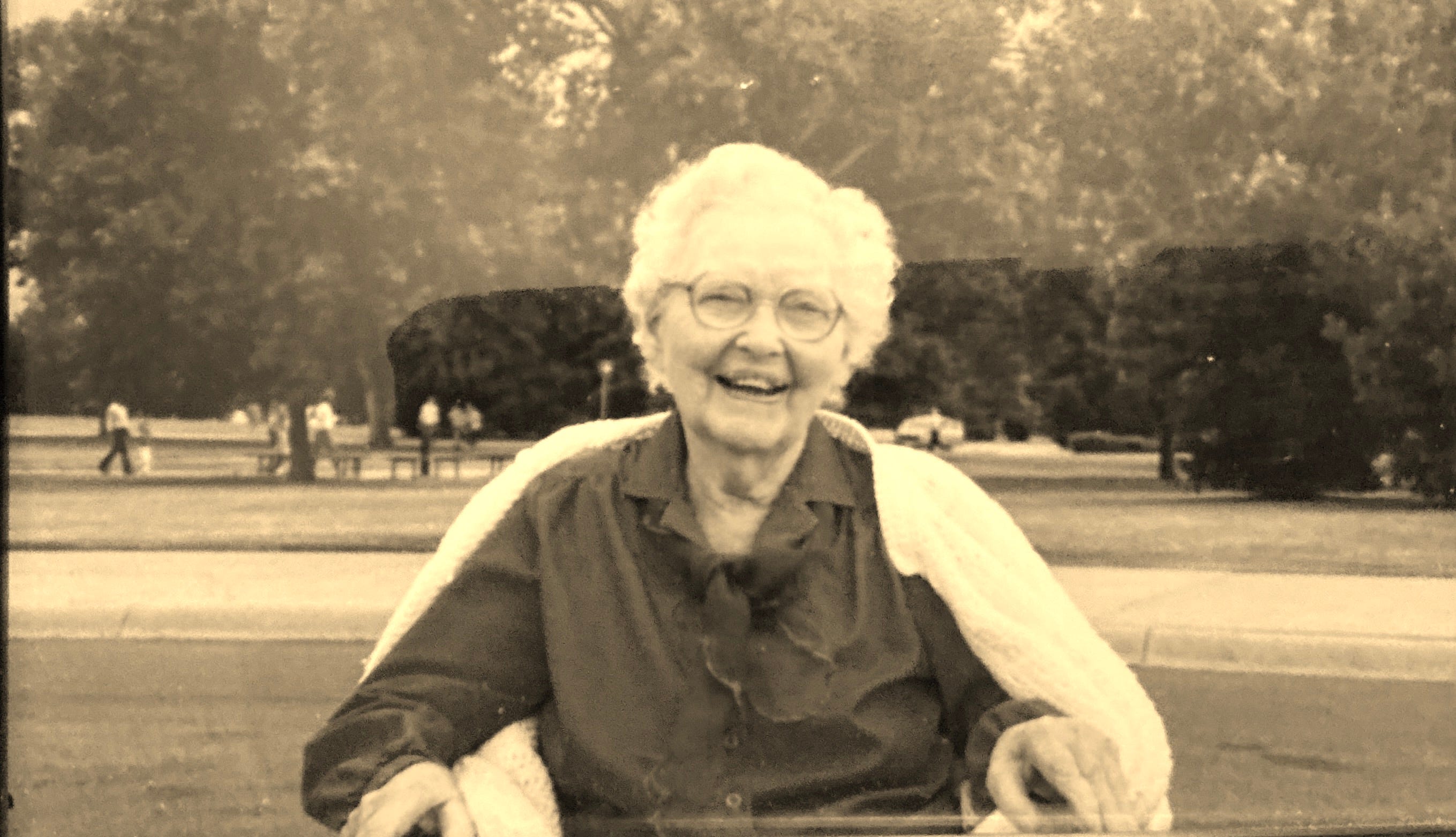
I remember my Aunt Eva still. She was born in 1897, and she raised me in the rural South, and each night before I went to sleep she would read me the Bible. I sat in her lap and began to know Jesus. If she were alive today, I would go back and sit there again. I would lay my titles and degrees at her feet and ask her to teach me of the Savior once more.
When I became a pastor, my Aunt Eva purchased a minister’s robe for me — a simple, humble covering to be used in consecrated service. She told me to wear it when I preach, like our home church pastor did, like the circuit riders from her childhood did, that I remember that I am handling the very Word of God, standing between heaven and earth, and delivering the bread of life to people made in God’s image (2 Timothy 4:2; John 6:35). And I did. But Aunt Eva, you taught me that long before, when I watched you, as I sat on your lap, and God spoke through you. Your pulpit was a rocking chair your mother gave you when you were sixty-five, and you found yourself with a baby, your little brother’s only child, born in his own later years. Your sanctuary was a room that was both bedroom, and living room. Your pastoral vestment was your apron, woven by dignity and wisdom, kindness, and humility. And your sermon and sacraments were given with a love that nourished and healed. Your theology became your biography. Your benediction was whispered to me as you lay dying. I will never forget you, nor could I. To borrow that line from Dan Fogelberg, I am “just a living legacy” of a country Christian woman, a widow, who had no children, little earthly possessions, but quietly served the King of kings, and Lord of lords. I have never called a woman, “mother,” but when I say, “Aunt Eva,” it feels like home.
To Every Woman
So whether you are a wife and mother, a single woman who has given herself to the children of others, a mother in a blended family, a birth mother who chose life at great cost, a married woman without children, a foster mother, a woman raising children alone, a young lady in college, or a little girl — the Bible has a word for you.
God has placed you in His great drama of redemption. You were made for Him. You were made for His glory (Isaiah 43:7). And in a way that is particular to you — that only you can embody — you were fashioned to declare and to live His salvation.
Your mothers did it before you. And, by His grace, you will carry it forward.
To all the rest of us: Show her the honor she is due (Proverbs 31:28–31; 1 Peter 3:7). And in doing so, you will be worshipping God who gave her to us.
In the name of the Father, and the Son, and the Holy Spirit. Amen.
Dr. Michael A. Milton is President of Faith for Living, Inc., an educator, retired Army Chaplain (Colonel), and a Teaching Elder (Honorably Retired) in the Presbyterian Church in America. He writes at Faith for Living on Substack and at publications such as The American Spectator.