A STUDY IN PSALM 121
FINAL INSTALLMENT

Dear Friends,
Greetings in the Lord. The study that follows completes our address of one of the ten most beloved scriptures: Psalm 121:1-2 (interested readers can locate the other nine here). Onward and upward to another soon, Lord willing.
Today, I am going through every subscriber to pray for you. There are many things I can no longer do. I can write (however painfully slow). I can pray (however embarrassingly weak). But the Holy Spirit moves us to pray, perfects our prayers, and the Savior presents our petitions to the Father who works all things together for our good. So, we pray in faith and leave our intercessions at the foot of the cross.
May you know the power of the reality of the resurrection in your life today.
Yours faithfully,
Mike
Now. To the hill country we journey in Psalm 121, a Song of Ascent, a traveling song, a tune to help us keep time with the promises of God. So, then, let’s go up yonder.
121 I will lift up my eyes to the hills—
From whence comes my help?
2 My help comes from the Lord,
Who made heaven and earth.
The Hills, the Darkness, and the Lord of All
Psalm 121:1–2
Psalm 121:1–2 is an affirmation of light made between the contours of darkness.
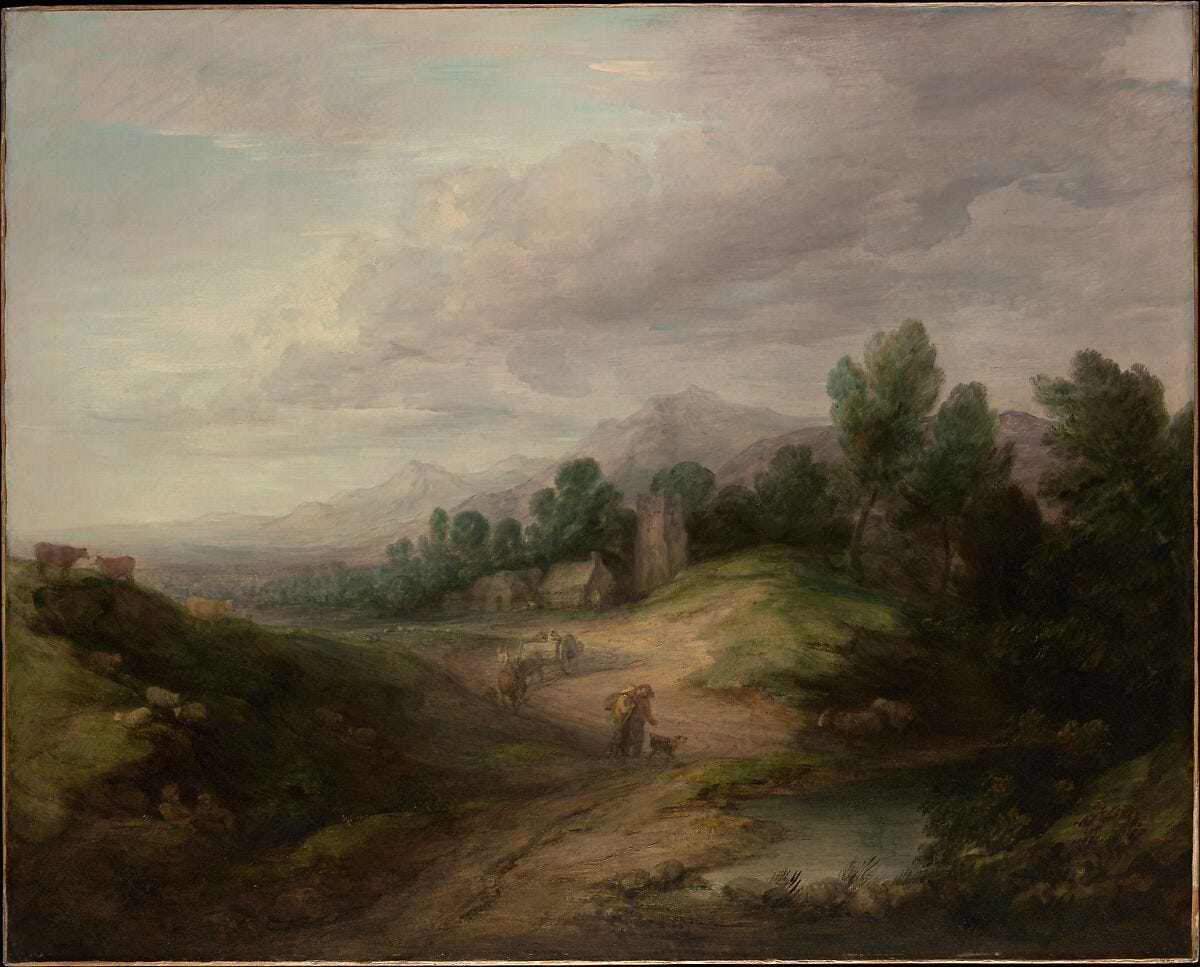
Those Israelites who went up to Jerusalem from the villages throughout Judea for the great festival of Passover did so on trails often surrounded by hills. Robbers and thieves, lunatics and heretics hid in those hills. The journey from home to holy city was an arduous one, filled with danger — the prospect of evil lying in wait at the high places. And there was more still. For the ancient Near Eastern peoples, and especially by the time of Second Temple Judaism heavily influenced by Persian thought (which had spread broadly among the post-Babel human migrations into Europe, Africa, and Asia), the high places also represented the abode of evil spirits. There were evil lords of the hills — principalities and powers that occupied both spiritual and terrestrial geography. The commentator Albert Barnes (1798–1870) describes a cosmology of the ancient Near East, including Judah, that understood a spiritual geography arranged in hierarchy: one class of evil spirits occupying the air, another the atmosphere, and yet others ranging beyond the globe into outer space and into metaphysical realms. They sought to control territories, to taunt and trouble human beings — if not far worse.
But we must not think this was merely a religious concept confined to pagans. Territorial spirits are a reality, and one that the Apostle Paul addresses on more than one occasion:
“For we do not wrestle against flesh and blood, but against principalities, against powers, against the rulers of the darkness of this age, against spiritual hosts of wickedness in the heavenly places” (Ephesians 6:12 NKJV).
“Giving thanks to the Father, who has qualified you to share in the inheritance of the saints in light. He has delivered us from the domain of darkness and transferred us to the kingdom of his beloved Son, in whom we have redemption, the forgiveness of sins” (Colossians 1:12–14 ESV).
“For in him all the fullness of God was pleased to dwell, and through him to reconcile to himself all things, whether on earth or in heaven, making peace by the blood of his cross” (Colossians 1:19–20)
“He disarmed the rulers and authorities and put them to open shame, by triumphing over them in him” (Colossians 2:15).
I could do no better than to quote my late friend, Professor Robert L. Reymond (1932–2013), who summed up the presence of evil and the territorial realms held by diabolical spirits:
“Paul took very seriously the reality of Satan and the kingdom of evil. He refers to our archfoe as Belial (2 Cor. 6:15), the Evil One (Eph. 6:16; 2 Thess. 3:3), the Ruler of the kingdom of the air (Eph. 2:2), Satan (Rom. 16:20), and the Tempter (1 Thess. 3:5). He works, Paul affirms, in the sons of disobedience (Eph. 2:2), blinds the minds of unbelievers so that they cannot see the light of the gospel of the glory of Christ (2 Cor. 4:4), turns men away from God to serve him (1 Tim. 5:15), takes men captive to do his will (2 Tim. 2:26), obstructs world missions (1 Thess. 2:18), and masquerades as an angel of light (2 Cor. 11:14). It was he who tormented Paul with a thorn in the flesh (2 Cor. 12:7).
Paul speaks of definite ‘power-aspects’ of Satan’s kingdom of darkness: the ‘reign of darkness’ (Col. 1:13), principalities and powers (Eph. 6:12; Col. 2:15), the powers of this dark world (Eph. 6:12), and spiritual forces of evil in the heavenly realm against which the man who lacks the whole armor of God cannot possibly stand (Eph. 6:12–13). Satan devises schemes (Eph. 6:11), ‘traps’ men (2 Tim. 2:26), and inspires false religions (1 Cor. 10:20).” — Robert L. Reymond, Paul, Missionary Theologian, 402–4031
Yet, Dr. Reymond spent so much time establishing the biblical case for spiritual realms and footholds of evil precisely in order to magnify the glory and majesty of Christ’s conquest: “Christ’s cross-work was a redemptive work of destruction and conquest!”2
That is a stunning statement and an accurate summary. Jesus went from overturning trading tables at the Temple to destroying demonic strongholds on the Cross.
The Baptist scholar, Dr. Thomas Schreiner (1954–), agrees with Dr. Reymond’s assessment and reminds us that the presence of evil does not constitute an equivalent duality:
“Paul is no dualist, seeing the devil and Christ locked in a mortal and equal combat. The devil and his forces are already defeated in Christ. Believers are to put on God’s armor and clothe themselves with the Lord’s strength. Since the victory over the devil and his associates has already been won, believers are summoned ‘to stand’” (Eph. 6:14). — Thomas R. Schreiner, Paul, Apostle of God’s Glory in Christ, 303.3
When the people of God marching up to Zion passed through those hills, they lifted their eyes and in theological defiance announced that Almighty God is the Lord of the Hills — because He is the Lord of all the universe. And why? Because the Lord God created the heavens and the earth (Genesis 1:1). The fall of mankind brought an unleashing of ungodly spirits, but the promise of God, already at work in the protevangelium (Genesis 3:15) and fulfilled perfectly in our Lord Jesus Christ, gave courage and hope to His people. The domain of the evil one was slipping away; and as Isaiah declared, a light would arise that would dispel the darkness from the face of the earth (Isaiah 9:2). Thus, believers in ancient Israel lifted their eyes to the hills and, as Matthew Poole (1624–1679), the Puritan Presbyterian commentator, wrote, in so doing they were “conflicting with great difficulties and oppositions,” yet turned their eyes “to God and his providence.”4
The brilliance of the light of Jesus Christ shines all the more when considered against the backdrop of suffering and death.
—Michael A. Milton “A Study in Psalm 121”
You and I can look up with defiant, Christ-centered faith — not only toward the presence of evil in the world and the suffering and sorrows that attend us all at one time or another, but also toward the specter of death itself. For the brilliance of the light of Jesus Christ shines all the more when considered against the backdrop of suffering and death. And so we join with the believers who in Psalm 121 looked upon those hills — a place of danger and even of evil — and encouraged themselves in the Spirit of the Lord by declaring that the Lord is God over all. We do not speak to demons or to spiritual realms (Jude 9), for we do not understand the fullness of the powers, hierarchies, or secret counsels of God that He has not revealed to us (Deuteronomy 29:29); but we do face them with the full confident faith that “He who is in you is greater than he who is in the world” (1 John 4:4 NKJV) — and greater still is He who has overcome and vanquished every territory of the enemy, even death itself (1 Corinthians 15:55–57).
So, keep moving towards the eternal Zion. And when the cast shadows of the surrounding hills seem to close in, look up, and sing the promises of God who has conquered and who is making a way through the darkness with the Light of the World.
In the name of the Father, the Son, and the Holy Spirit.
NOTES FOR FURTHER STUDY
On Psalm 121:
John Calvin and James Anderson, Commentary on the Book of Psalms (Bellingham, WA: Logos Bible Software, 2010), 5:62.
Tremper Longman III, Psalms: An Introduction and Commentary, ed. David G. Firth, Tyndale Old Testament Commentaries (Nottingham, England: Inter-Varsity Press, 2014), 413.
Albert Barnes, Notes on the Old Testament: Psalms (London: Blackie & Son, 1870–1872), 232.
C. H. Spurgeon, “The Well-Beloved’s Vineyard,” in The Metropolitan Tabernacle Pulpit Sermons (London: Passmore & Alabaster, 1912), 443.
Matthew Poole, Annotations upon the Holy Bible (New York: Robert Carter and Brothers, 1853), 2:193.
Spiritual Realms — Key Scripture References (Expanded)
Old Testament
• Genesis 3:1–15 — The serpent as adversary; the protevangelium and the first promise of Christ’s victory over the seed of the evil one
• Genesis 6:1–4 — “Sons of God” and the corruption of the terrestrial realm; spiritual beings acting upon human history
• Deuteronomy 32:8–9 — God divided the nations “according to the number of the sons of God” — the foundational Old Testament text for territorial spirits and spiritual assignment over peoples
• Deuteronomy 32:16–17 — Those same spirit-beings described as “strange gods” and demons; idolatry as spiritual occupation
• Job 1–2 — Ha-satan (“the adversary/accuser”) presenting before the divine council; spiritual access to and influence over terrestrial life
• Psalm 82:1–8 — God judges the elohim of the divine council who have corrupted their rule over the nations; the high court of heaven
• Psalm 89:5–7 — The assembly of the “sons of God” in the heavenly court; God feared above all in that council
• 1 Kings 22:19–23 — Micaiah’s vision of the heavenly council; a lying spirit among the host of heaven sent to deceive
• Isaiah 14:12–14 — The fall of Lucifer; spiritual pride and the attempted usurpation of divine authority
• Isaiah 24:21 — “The Lord will punish the powers in the heavens above and the kings on the earth below” — cosmic and terrestrial judgment in tandem
• Ezekiel 28:12–16 — The king of Tyre addressed as a fallen spiritual being; the anointed cherub cast from Eden
• Daniel 10:12–21 — The “prince of Persia” and “prince of Greece” — the classic Old Testament territorial spirits passage; Michael as warrior-angel contending for God’s people
• Zechariah 3:1–2 — Satan as adversary and accuser before the divine council; the Lord rebukes him
Words and Encounters of Jesus
• Matthew 12:28–29 / Luke 11:20–22 — The “strong man” parable: Jesus explicitly describes binding the strong man and plundering his house — direct teaching on spiritual strongholds and their overthrow
• Mark 5:1–13 — The Legion demons plead not to be sent out of the region — a vivid demonstration of territorial spiritual attachment
• Luke 10:18 — “I saw Satan fall like lightning from heaven” — Jesus’s eyewitness testimony of the original defeat
• Luke 22:53 — “This is your hour, and the power of darkness” (already in list)
• John 12:31 — “Now the ruler of this world will be cast out”
• John 14:30 — “The ruler of this world is coming, and he has nothing in me”
• John 16:11 — “The ruler of this world has been judged”
• Revelation 2:9–10 — Jesus identifies the synagogue at Smyrna as belonging to Satan
• Revelation 2:13 — Jesus names Pergamum as the place “where Satan’s throne is”
New Testament (Apostolic)
• Ephesians 6:12 — Principalities and powers of darkness (already in list)
• 2 Corinthians 4:4 — “The god of this age has blinded the minds of unbelievers”
• 2 Corinthians 10:3–5 — “Pulling down strongholds” — the New Testament’s most direct use of the stronghold metaphor in spiritual warfare
• Romans 8:38–39 — Neither angels, nor rulers, nor powers can separate believers from the love of God in Christ
• 1 Peter 5:8 — “Your adversary the devil prowls around like a roaring lion, seeking someone to devour”
• James 4:7 — “Resist the devil and he will flee from you”
• 1 Peter 2:9 — Called out of darkness into marvelous light (already in list)
• 1 John 1:5–2:11 — Darkness and light as spiritual states (already in list)
• Acts 26:18 — From darkness to light (already in list)
• Revelation 12:7–9 — War in heaven; Satan and his angels cast down — the cosmic scope of spiritual conflict
• Revelation 20:1–3 — Satan bound; the final curtailment of his power
A Select Bibliography on Terrestrial Spiritual Power Structures:
James M. Efird and Mark Allan Powell, “Demon,” in The HarperCollins Bible Dictionary, ed. Mark Allan Powell (New York: HarperCollins, 2011), 192.
Albert Barnes, Notes on the New Testament: Ephesians, Philippians & Colossians, ed. Robert Frew (London: Blackie & Son, 1884–1885), 126.
David Prior, The Message of Joel, Micah and Habakkuk, ed. J. A. Motyer and Derek Tidball, The Bible Speaks Today (Nottingham: Inter-Varsity Press, 1988), 278–279.
G. H. Twelftree, “Spiritual Powers,” in New Dictionary of Biblical Theology, ed. T. Desmond Alexander and Brian S. Rosner (Downers Grove, IL: InterVarsity Press, 2000), 799.
Richard D. Phillips, 2 Samuel, Reformed Expository Commentary (Phillipsburg, NJ: P&R Publishing, 2018), 195.
Robert L. Reymond, Paul, Missionary Theologian (Scotland: Christian Focus Publications, 2000), 402–403.
Thomas R. Schreiner, Paul, Apostle of God’s Glory in Christ: A Pauline Theology (Westmont, IL: IVP Academic, 2006), 303–304.
Robert L. Reymond, Paul, Missionary Theologian (Scotland: Christian Focus Publications, 2000), 402.
Reymond, 403.
Thomas R. Schreiner, Paul, Apostle of God’s Glory in Christ: A Pauline Theology (Westmont, IL: IVP Academic, 2006), 303.
Matthew Poole, Annotations upon the Holy Bible (New York: Robert Carter and Brothers, 1853), 2:193.
You might want to check out . . .
How to Lead a Bible Study. A method I used in teaching seminary students (to teach in their churches), published as an article by Crosswalk.com.